Personal Electric Vehicles: A Position

1. Overview
The range of vehicles Vermont law recognizes is far too narrow. No danger category comes into existence between a bicycle and a car. A vehicle does not become uniquely hazardous by weighing more than twenty pounds and less than three thousand. The presumption otherwise has no real basis in science.
Vermont's current regulatory framework fails in four connected ways. First, it enumerates vehicle types: Title 23 already defines bicycle, motor-assisted bicycle, electric bicycle (three classes), electric personal assistive mobility device, motor-driven cycle, and motorcycle. Six categories, none of which fits an electric unicycle or an electric skateboard, and every new form factor demands new legislation. Second, it regulates shape: definitions built around handlebars, floorboards, pedals, and brake levers select against the devices best suited for paths and multimodal transit, on criteria with no empirical basis in safety. Third, it caps capability: limiting what a vehicle can do rather than what a rider does inverts the principle we already apply to the heaviest vehicles on the road. Fourth, there is the partition trap, sorting vehicles into road-only and path-only categories, which unfairly defeats the appeal and utility of the very devices it claims to regulate. Vermont has not fallen for this one yet, but other states have, and it is worth pointing out here because it is the natural next mistake once a legislature starts drawing vehicle-type lines.
None of these failures are malicious. Each was a reasonable attempt to keep roads safe and enforcement simple, and until recently the consequences were mostly theoretical — the vehicles that fell through the cracks barely existed. That is no longer true. The technology is changing fast enough that these inherited shortcuts now determine which vehicles are legal, and they were never designed to bear that weight. It is time for a second look.
The structure that works is one in which access nests. Roads admit every vehicle; paths admit a subset drawn by function, not form. Bicycles already occupy exactly this position — legal on ordinary roads including fast arterials, excluded from interstates by speed, not by type. Nothing novel is requested.
No small electric vehicle should be unregisterable in Vermont. The current patchwork of six-plus enumerated categories should be replaced with a framework based on weight and top speed — metrics that actually correlate with harm. Four tiers:
- Low-speed personal electric vehicles. Light, speed-limited devices. No identification required. Admitted to roads and paths, subject to path conduct rules. This is the bicycle-equivalent tier: the regulatory burden is near zero because the risk profile is near zero.
- Personal electric vehicles with no speed restriction. Carryable devices that can keep up with road traffic. Require identification and carry age restrictions, but no registration. Admitted to roads and paths, subject to posted path speed limits. This is the tier that makes micromobility genuinely useful for transportation — a device that does thirty-five on the arterial and twelve on the bike path.
- Heavy, low-speed vehicles. Above the carryability boundary but speed-limited. Require age restrictions but no registration. Admitted to roads and paths. This is the cargo bike tier — heavier devices that are already widely accepted on paths and among the most valuable car-replacement vehicles in existence.
- Heavy, fast vehicles. Above the carryability boundary and capable of higher speeds. Require an affordable, proportionate registration and a driver's license. These are the e-motos and their successors — road-legal, not path-eligible.
I would suggest the weight and speed capability boundaries be set at 100lb and 20mph accordingly.
The tiers are defined by what the vehicle weighs and how fast it can go, not by whether it has handlebars, a floorboard, pedals, or any particular number of wheels. A device that does not fit the current enumeration does not fall through the cracks; it falls into whichever tier its weight and speed place it in. No new legislation is required when a new form factor arrives. And weight alone does not exclude a vehicle from the path — a heavy, slow cargo bike and a light, fast PEV both belong there, for different reasons, under the same conduct rules.
The concrete asks are as follows. Almost every conceivable vehicle belongs on the ordinary road network; the four-tier framework above makes this operational. Tiers one through three should be admitted to paths and bike lanes, subject to conduct rules and a posted operating limit. Tier four should be regulated as the motor vehicles they already are under state law. And path conduct rules should apply to everyone on the path, defined by what a vehicle is and how it is operated rather than by shape.
The author rides an electric unicycle, which is among the devices this paper addresses.
2. Path Access and Why Capability Restrictions Are Wrong
Tiers 1 through 3 should be allowed on paths and bike lanes, subject to conduct rules and a posted operating limit. Only tier 4, heavy and fast, is excluded. The four-tier framework in Section 1 classifies by weight and speed. What it deliberately excludes as criteria — power ratings, capability caps, and shape requirements — matters just as much. Each of these is a restriction that sounds reasonable and produces the opposite of its intended effect.
Why power caps are counterproductive. Power ratings are the wrong instrument for self-balancing vehicles, and capping them produces the opposite of the intended effect.
On a conventional vehicle, motor power is a rough proxy for speed and acceleration. On a self-balancing personal electric vehicle it is neither. The motor sits inside the balance loop, the continuous feedback cycle in which the device keeps the rider upright by accelerating the wheel beneath their center of mass, faster than gravity can pull them past it. Peak power draw exists to serve that correction, not to serve top speed.
Headroom, the gap between the motor's maximum output and the power currently required for balance, is therefore a safety margin. A wheel that runs out of torque under load does not slow down gracefully; it stops holding the rider up. Tiltback, the primary mechanism these devices use to enforce a speed limit, works by deliberately spending some of that margin: the device tilts its platform backward to push the rider's weight behind the axle, forcing a deceleration. A device with no margin to spend cannot warn its rider at all.
A power cap on a self-balancing personal electric vehicle does not produce a slower vehicle. It produces one that fails under precisely the conditions where the rider most needs it not to: a heavy rider, a steep grade, a sudden stop.
This is a specific case of a general problem: technical mandates written with one class of vehicle in mind produce unpredictable results when applied to another whose failure modes the drafter has not studied. Where the concern is speed, regulate speed.
Why capability is excluded. Nearly every car on the American road is capable of speeds unsafe on every road in the country. Nothing prevents it. No government governs that capability. A capability cap on personal electric vehicles inverts the principle: it governs the lightest vehicles where it has never governed the heaviest. The full argument, including the enforcement rebuttal and the fee-scaling problem, appears in Section 5.
But capability is not only a fairness question; it is also what makes micromobility useful. A device that can keep up with thirty-five-mile-per-hour traffic on an arterial and is compact enough to be welcome on a bike path is a genuinely useful transportation tool — it can complete a real trip across both environments. Cap its capability to path speeds and it can no longer hold a lane on the road; it is confined, dangerously and unnecessarily, to the shoulder as cars pass. The capability restriction does not merely invert a principle. It hobbles the dual-use value that makes the vehicle worth owning in the first place. As long as the rider follows the posted limit on the path and the traffic law on the road, the device's capability is not the problem.
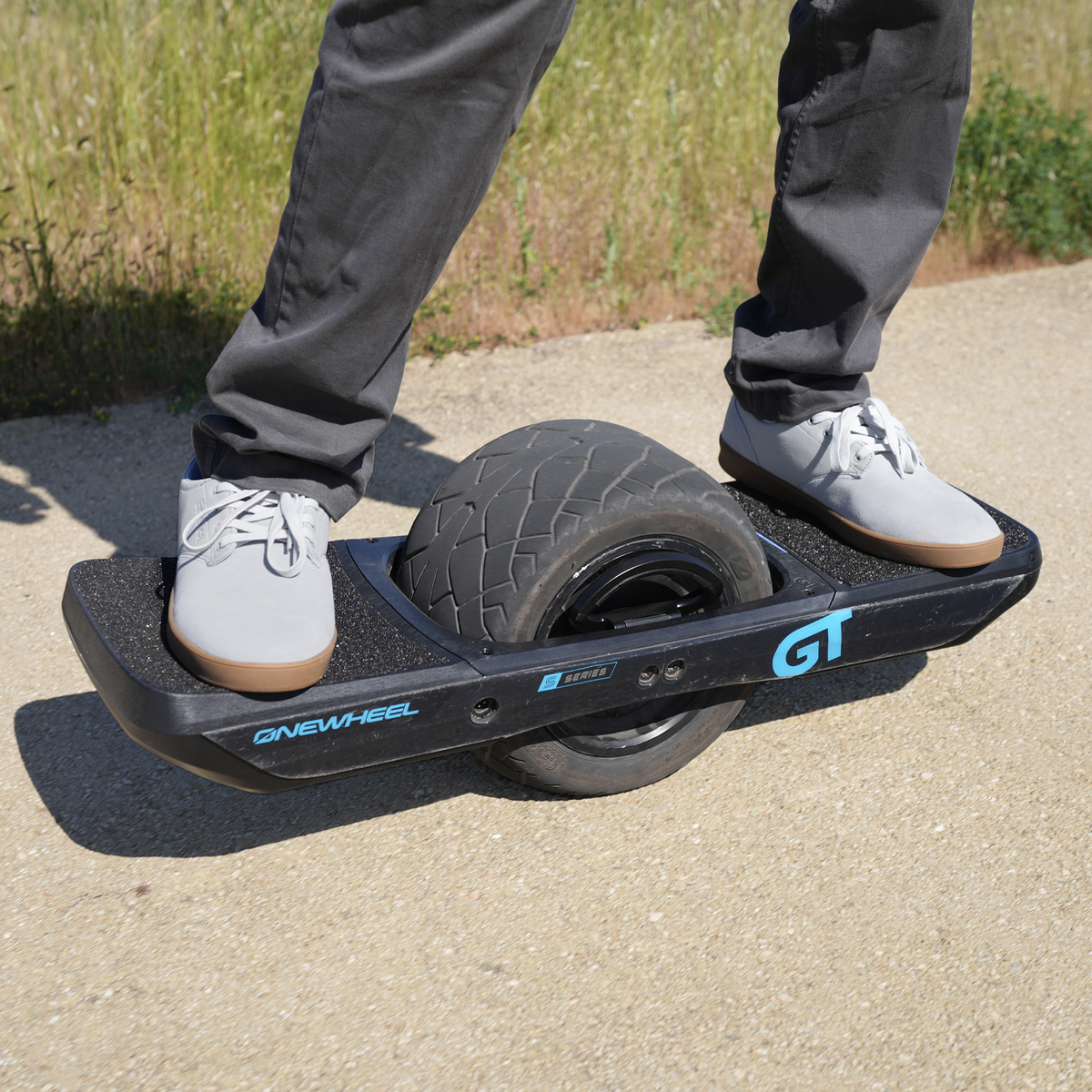
One definition covers an electric unicycle, a standing scooter, an electric skateboard, a seated wheel, and devices not yet built. These devices share no shape. They share an operating envelope (electrically powered, single-rider, carryable) which is what actually determines how they behave around other people. That is the basis on which path access should be granted or withheld, and it is the only basis that will survive the next form factor without requiring new legislation.
3. Accepted Constraints
The following constraints are accepted as part of any path-access framework for personal electric vehicles:
- A posted, enforced, path speed limit of 15-20 miles per hour for electrified riders
- Yielding to pedestrians, unconditionally
- Audible signal before passing
- Lights after dark
- Age limits enforced on PEVs capable of high speed
- No e-motos allowed
4. What Current Law Gets Wrong
The Enumeration Failure
Title 23 already defines six vehicle categories: bicycle, motor-assisted bicycle, electric bicycle (three classes), electric personal assistive mobility device (EPAMD), motor-driven cycle, and motorcycle. None fits an electric unicycle. The EPAMD category, which might seem closest, explicitly requires "two nontandem wheels," excluding single-wheeled devices by definition. 23 V.S.A. Section 4
The enumeration approach is not hypothetically fragile. It has been tried, and it is already failing. Each new form factor that does not match an existing definition requires new legislation — a process that takes years even when the political will exists, and that leaves the device in legal limbo in the interval. The problem is structural: an enumerated list cannot accommodate what it does not anticipate, and the pace of vehicle development now exceeds the pace of legislative revision.
The Shape-Regulation Trap
This type of regulation does not just miss devices — it selects against the right ones. When a statute defines a vehicle by the presence of handlebars, floorboards, pedals, or a brake lever, it is regulating shape. None of these criteria have an empirical basis in safety. A floorboard does not make a vehicle more stable. A brake lever is not the only mechanism that stops a wheel. Pedals are not what make a bicycle slow enough for a path.
What shape criteria do is draw a line around familiar silhouettes. That line has two consequences, both bad.
It excludes the best path candidates. The devices that fit on a bike path without conflict — compact, narrow, carryable — are precisely the ones that do not look like a bicycle or a scooter. An electric unicycle, an electric skateboard, a one-wheeled self-balancer: all narrow, all controllable at low speed, all excluded by a handlebar requirement.
It encodes the false premise that a vehicle must be large enough in a particular way to be safe. A floorboard requirement is a width-and-stance mandate by proxy. A two-wheel minimum is a stability mandate by proxy. Neither has been tested. Self-balancing vehicles are stable by a mechanism the drafter has not studied, and narrow vehicles produce less conflict on a shared path, not more.
New York's definition of an electric scooter requires "handlebars" and "a floorboard or a seat," a shape rule wearing a safety label. N.Y. VTL Section 114-e It excludes regenerative braking, electronic braking, and lean-to-stop (a deceleration method in which the rider shifts weight rearward and the device's control system translates that input into braking force). All of these exist, all of them work, and none of them can be recognized by a lever-or-pedal rule.
Shape regulation is capability regulation laundered through form factor. It does not test whether a vehicle can stop; it tests whether the vehicle stops the way a bicycle does. Where the concern is braking distance, the instrument is a braking-distance standard.
New Jersey offers a worked example. A 2005 definition written for pocket bikes (P.L.2005, c.159; N.J.S.A. 39:4-14.12) now reaches devices nobody imagined when it was drafted. The 2026 amendment (P.L.2025, c.285, effective January 19, 2026) replaced the three-class e-bike system, required registration and insurance for throttle e-bikes, and made New Jersey the first state to require e-bike insurance — while low-speed electric scooters, defined by the presence of a floorboard and handlebars, remain exempt. First-in-nation means template: other states copy.
Municipal codes inherit the same defect and propagate it, because towns copy neighbors rather than drafting from first principles. Current illustrations, as of this writing:
- Colchester Section 12-50(a) defines a bicycle as "any non-motorized wheeled vehicle that is propelled manually by pedals," with the result that none of Article V's conduct rules — yield, audible signal, reasonable speed, lights — reach any electric device. Colchester Code Ch. 12, Art. V
- Colchester Section 12-52(d) requires riders to "maintain one (1) hand on the handlebars of a bicycle at all times" — a form-factor mandate that no one intended and that has no safety basis for devices steered by other means.
- Burlington Parks and Recreation path signage reading "No e-motos, motorcycles or unauthorized vehicles" — an undefined category posted on a public path.
The general claim matters more than any single citation. If Colchester amends its code tomorrow, the pattern persists: definitions built on form factor exclude the devices they should govern and include the ones they should not.
The Partition Failure
Another pitfall — one that states including New Jersey are falling into as we speak — is partition: type A vehicles for roads, type B for paths. It unfairly defeats the appeal and utility of the very devices it claims to regulate, and it is the access-structure version of the same error: regulating by vehicle type rather than by conduct.
Partition converts transportation into recreation. The road network is the only connected one; paths reach few origins and fewer destinations. A vehicle barred from the road cannot complete a trip regardless of how much path access it is granted. It becomes a toy.
Partition also concentrates the conflict it means to reduce. Bar a slow vehicle from the road and it moves to the sidewalk, which is where pedestrian complaints originate. Exclusion does not eliminate conflict; it relocates it onto the least protected users.
The alternative is nesting. Roads admit every vehicle, except limited-access highways, where the exclusion is a minimum-speed rule rather than a vehicle-type rule. Vermont law already embodies this principle: 23 V.S.A. Section 1139 excludes bicycles from fully controlled-access highways while permitting them on shoulders of partially controlled-access highways per the traffic committee's determination. 23 V.S.A. Section 1139 Paths admit a subset, drawn at the category line defined in Section 2. The nesting model requires both halves to be stated: universal road access for all vehicles, and path access for the defined subset under conduct rules.
5. Burden Should Scale with Harm
The principle underlying every specific claim in this paper is proportionality: regulatory burden should scale with the harm a vehicle can cause.
The Precedent
This is not a novel idea. The United Kingdom's Highway Code, revised effective January 29, 2022, codified it as Rule H1: "Those who can do the greatest harm have the greatest responsibility to reduce the danger or threat they may pose to others." The hierarchy runs from pedestrians through cyclists, horse riders, and motorcyclists to cars, vans, and heavy goods vehicles. GOV.UK: Highway Code changes, January 2022 The principle is already operational in a G7 country. What follows applies it to the specific question of personal electric vehicles on Vermont roads and paths.
The Arithmetic
The relevant measure is system mass and speed, not device weight alone. On any personal electric vehicle, the rider constitutes most of the system mass. A forty-six-pound electric unicycle carrying a rider at nineteen miles per hour sits inside the band of vehicles the path was built for — comparable to a fit road cyclist on a twenty-pound bicycle doing twenty-two. The kinetic energy and momentum are of the same order. Whatever risk the path was designed to tolerate when it admitted bicycles, it already tolerates at this scale.
We Never Governed What Cars Can Do , so why Start with the Smallest Vehicles?
Nearly every car on our Vermont roads are capable of speeds unsafe on any road on the continent. A base-model sedan will run comfortably past one hundred. Nothing prevents it — not a governor, not a regulation, not a manufacturer requirement. We decided long ago that for the heaviest and most lethal vehicles in common use, capability is not the government's business and conduct is.
That decision was correct. It should be applied consistently.
To cap the top speed of a personal electric vehicle is to ask the state to do to the lightest powered vehicle on the road what it has never been willing to do to the heaviest. It inverts the principle precisely: it governs capability where the risk falls mainly on the rider, and leaves capability ungoverned where the risk falls on everyone else.
It also falls unevenly. A capability cap makes the cheapest form of independent motorized mobility artificially inferior while leaving the most expensive form untouched. The person who can afford a car keeps a vehicle that will do one hundred. The person who cannot is issued a slower one by law.
If mechanical speed governance were a serious policy, if we believed vehicles should be built incapable of exceeding safe speeds, the place to begin is not a forty-six-pound PEV. It is the three-thousand-pound machine in every driveway in Vermont, capable of at least twice the highest posted limit in the state.
The Obvious Counterargument
The reply is that cars get away with uncapped capability because drivers carry plates, registration, and insurance. Fine. That is kind of exactly how my idea for a four-tier framework works: a more capable vehicle requires proportionately more paperwork, and a less capable one requires less. A tier-1 device requires nothing. A tier-4 device requires registration and a license. The rider who wants more capability can have it by accepting more red tape. The rider who does not can hit the road with none. What my proposed framework does not do is cap what any device is built to do. The United States has never governed the top speed a passenger car is capable of reaching, and there is no good reason to start with the smallest vehicles on the road.
Fees Must Scale
A flat registration and insurance requirement on a two-hundred-dollar device is a cost a truck owner does not notice and a personal electric vehicle owner may not be able to bear. A personal electric vehicle costs on the order of five percent of a car — entry-level electric unicycles run one thousand to two thousand dollars (Kingsong pricing guide; Epic Cycles), against an average new car transaction price of approximately forty-nine thousand dollars (BLS/MoneyGeek). Imposing the same nominal registration and insurance burden on both is not parity; it is a twentyfold difference in real burden. This is not an argument that a personal electric vehicle can never be registered. It is an argument that identical nominal burdens produce wildly unequal real ones, and that proportionality requires burden to scale with the vehicle.
New Jersey is the demonstration. P.L.2025, c.285, the first state to require e-bike insurance, applied license, registration, and insurance to low-speed devices. It did not regulate them — it priced them out. And its scooter exemption is itself a shape-regulation artifact: low-speed electric scooters remain exempt because they have a floorboard and handlebars.
6. E-Motos
The proportionality principle does not always argue for less regulation. Applied to e-motos, high-speed heavier electric two-wheelers, it argues for more.
A sixty-pound machine at thirty-five miles per hour with an unlicensed teenager aboard should carry more regulatory burden than a bicycle. The four-tier framework in Section 1 places these devices in tier four: above the carryability boundary, high-speed, road-legal, requiring registration and a driver's license, not path-eligible.
The relevant fact is that e-motos are already illegal to operate without proper credentials. Under 23 V.S.A. Section 4, they are motor-driven cycles — registration, license, and insurance are required. The gap is not in the law; it is in enforcement. Colchester's school resource officer has resorted to calling parents of e-moto riders to inform them that the devices are illegal for riders under sixteen. Some parents had not known. (Seven Days, "Concerns Mount Over Young Riders Operating E-Bikes and E-Motos"; VTDigger, "Is this the summer of the e-moto?" June 13, 2026)
New device categories will not close an enforcement gap. They will capture new devices while the fast, heavy ones that prompted the concern keep going. The solution is to enforce the law that already exists, which correctly identifies e-motos as motor vehicles and correctly requires a license to operate them.
There is also a collective-action problem worth naming. Without a clear legal floor, every parent who says no is not just setting a rule — they are isolating their kid from the group. The other kids are riding around together, and yours is not. That is a harder thing to ask of a parent than simple prohibition. Enforcing the already-existing law removes the dilemma entirely.
7. Why This Is Worth Getting Right
7a. Emissions
Transportation is Vermont's largest greenhouse gas emissions sector, accounting for approximately forty percent of statewide emissions. (VT Greenhouse Gas Inventory 1990-2022; preliminary 2024 data shows no significant change per ANR press release, February 21, 2025.) The emissions come from the trips. Every trip a household can make without starting a car is one that does not contribute to the sector. Rural geography leaves Vermont with few realistic ways to cut that number, which means essentially, every little bit counts. PEVs will not decarbonize Vermont transportation on their own, but they have the potential to represent a staple part of a holistic transit solution.
7b. Car Dependency
Vehicle ownership is the second-largest household expense after housing nationally — housing at 32.9 percent, transportation at 17.0 percent of total expenditures. (BLS Consumer Expenditures, 2024) But the aggregate number understates the real problem. Car dependency is an economic depressant and an inequality enforcer. And the same rural geography that limits Vermont's options on emissions limits its options here: the state cannot deliver meaningful social services at a low per-capita cost when the population is this dispersed. Every tool that reduces a household's vulnerability to car dependency matters more in Vermont than it would in a state with alternatives.
For lower-income households, a surprise repair bill is not an inconvenience; it is a crisis. Without your car, you cannot get to work. Without work, you cannot pay for the car. The spiral from a breakdown to job loss to housing instability is not hypothetical; it is a well-documented path, and it falls hardest on the people least able to absorb the shock.
Personal electric vehicles should be understood as a backup plan. A device that costs a fraction of a car, requires almost no maintenance, and can cover a daily commute under twenty miles does not replace a car for every trip. But it means that when the car is in the shop, or when a household cannot afford a car at all, there is still a way to get to work. And when the commute is too long to ride the whole way, a carryable PEV can be taken onto a bus or into a rideshare that only covers part of the route. That option did not exist at this price point five years ago. Foreclosing it by regulatory accident would be a serious mistake.
7c. What Personal Electric Vehicles Actually Do: Extend Transit's Reach
A transit stop serves people who can walk to it. The standard planning assumption is a quarter mile for bus stops and half a mile for rail stations. (APTA, "Defining Transit Areas of Influence"; see also Guerra, Cervero, and Tischler, "Half-Mile Circle: Does It Represent Transit Station Catchments?", noting the standard is a planning rule of thumb rather than a rigorously derived figure.)
A PEV that can be carried onto the bus extends that radius several-fold. And catchment area scales with the square of the radius. Same stop, many times the coverage, zero capital cost, no route changes required. The device does not compete with transit; it multiplies the value of transit already built. In a low-density state, that is the difference between a route being viable and not.
This argument works only if the device is carryable, and that is the durability argument arriving from the other direction. The form factors current law blesses, those defined by handlebars, floorboards, pedals, and two wheels, are precisely the ones that cannot board a bus at rush hour. This is Section 4's shape-regulation trap producing its most concrete harm: the criteria that make a vehicle look right to a drafter are the same criteria that make it too wide or too awkward to carry through a bus door. Shape-based rules do not just risk banning good devices by accident. They systematically select against the ones that solve Vermont's actual geometry. A handlebar requirement is, in practice, a prohibition on transit-compatible electric vehicles.
7d. Do Not Foreclose What Has Not Been Invented
The last decade produced form factors nobody would have predicted, on battery, motor, and controller curves that have not flattened. Whatever the most useful vehicle of the next decade looks like, it will not match a definition written today, just as a 2005 definition failed to anticipate anything now on the path.
The ask is not special treatment. It is that Vermont define the category by what a device does — how it is built and how it is operated — so the definition survives the next form factor without amendment. States that define by shape will re-legislate every few years and be wrong in the interval. A definition built on function (electrically powered, single-rider, carryable) does not need to be rewritten when someone builds a better wheel, a different frame, or a control mechanism no one has seen before.
This is a drafting argument. A town attorney or a legislative counsel can accept it without agreeing with anything else in this paper.
7e. The Honest Limits
Someone will call these four-month vehicles. Seasonal utility is still utility. The paths are seasonal, the bike ferry is seasonal, school athletics are seasonal, and the shoulder seasons in Vermont run longer than most people assume. The claim is not that a personal electric vehicle replaces a car year-round. The claim is that for the trips it can serve, during the months it can serve them, nothing else in the same price range comes close.
8. Conclusion
Micromobility is not a novelty. It is a crack in the wall of car dependency that we have spent seventy years building around ourselves. It could put independent transportation within reach of people who have never had it. It could mean that "do you have reliable transportation?" stops being a hiring filter that shrinks the labor pool for every small business in the state. It could challenge our systemic American bias towards low-density development that we have treated as fixed for so long we forgot it was a choice. None of that happens if we regulate it out of existence before anyone gets the chance to see what it can do.
The smaller the vehicle, the freer it should be.
This paper addresses Vermont state law (Title 23) and the drafting patterns that shape local regulation of personal electric vehicles. It is current as of July 2026 and may be revised as the law develops.